
The Hospital Menonita Dissent Demonstrates Why Loper Bright Must be Constitutionalized
By
| August 18, 2026
By John J. Vecchione
Ryan Mulvey has ably discussed the implications of the history and holding of Hospital Menonita de Guayanma v. NLRB in these pages. To sum up, the NLRB had a successor-bar rule requiring that an employer deal with a union for a year after taking over the company based on an irrebuttable presumption it had majority-employee support until at least a year after the successor took over. The D.C. Circuit had previously given deference to the NLRB’s rule even though there was evidence that union support had dropped below a majority. It is of special consequence that the case was remanded to the D.C. Circuit in light of the holding in Loper Bright. The issue seemed to be whether the opinion would come out the same if no deference was given to the NLRB.
Judge Randolph’s dissenting opinion is interesting even if, as we shall see, his “footnote two” presages the real meat of the fight on deference ahead. Randolph determined that the remand was to determine and interpret whether Congress had delegated discretionary authority to determine the successor-bar issue to the NLRB. He completely rejected the idea that the Circuit had used Chevron at all in the original decision. Like many courts that favor agency discretion, he focused on the portion of Loper Bright that notes how Congress can impart discretion on an agency by statute. One of the fascinating portions of the dissent is when he compares Justice Scalia’s Duke law review article supporting Chevron deference across the board with Judge Fred Friendly’s preference for statute-by-statute decisions on the extent of deference cited in Judge Randolph’s own NYU law review article on administrative law. Judge Randolph clerked for the legendary Friendly and fifty years later defends his legacy, predicting he would have resisted Chevron’s “reflexive” deference. Randolph then goes on to say that the best reading of the NLRA is that it gives the NLRB the discretion to make rules like the successor-bar rule and the original panel decision was correct.
This is an important decision out of the D.C. Circuit on how Loper Bright will be interpreted in the main administrative circuit in the land. But the real shot across the bow in Judge Randolph’s dissent is his second footnote:
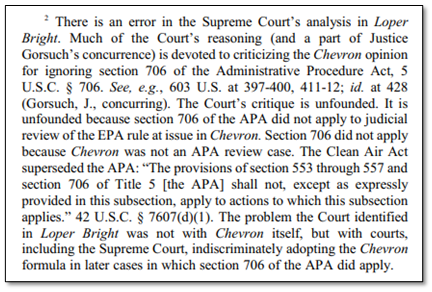
Here, Randolph posits that Loper Bright erred in stating that Chevron was wrong not to address the APA—and, specifically, Section 706—upon which Loper Bright ultimately turned. According to him, the Clean Air Act had its own review standards that superseded those of the APA. Yet, this is in dispute, as I am indebted to Professor Jonathan Adler of the Volokh Conspiracy for making me aware. According to at least one scholar, the agency action at issue in Chevron was not subject to the CAA’s specific judicial-review provision, as the EPA itself concluded in its rulemaking. Thus, the default standard of Section 706 would have applied.
Whatever the true answer, Randolph’s footnote points to big legal conflicts to come. It is likely the issue of whether Congress has delegated discretion to an agency will continue to work itself through the courts statute-by-statute, in the manner Judge Randolph suggests. But the issue he has flagged will come back again and again. Until the reasoning of Loper Bright is adopted as a constitutional principle, it remains vulnerable to certain statutory schemes. The Relentless petitioners, in particular, strongly urged the Supreme Court to adopt the positions articulated by Justices Gorsuch and Thomas in their concurring opinions in Loper Bright.
The Constitution requires Loper Bright whether the APA says so or not. The idea of judicial deference to the legal views of agencies directly conflicts with the “judicial power” conferred on courts by Article III of the Constitution. In using the doctrine of “constitutional avoidance,” and resting Loper Bright on the APA, the Supreme Court has invited efforts like those of Judge Randolph here to distance each statute from APA review—which is particularly easy to do when the statute says the APA doesn’t apply—and grant deference to agencies that way. There are a host of deference doctrines that may not fall under the APA in certain cases. This should not lessen the “judicial power” on Article III and the judicial duty to find the best reading of the statute even in cases not governed by the APA. The sooner the Court takes up this anomaly and corrects it, the sooner the separation of powers and judicial independence will be placed on firmer footing.
John J. Vecchione is senior litigation counsel at New Civil Liberties Alliance and counsel of record in Relentless v. Commerce.

