
SCOTUS Appoints Amicus to Defend Stinson Deference
By
| May 7, 2026
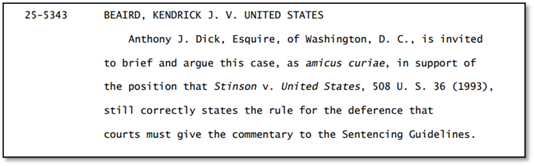
Last month, the Supreme Court granted certiorari in Beaird v. United States, indicating it would consider whether Stinson v. United States “still correctly states the rule for the deference that courts must give the commentary to the Sentencing Guidelines.” As I explained at the time, this move not only “opens the door for reconsideration of another judicial-deference doctrine,” but more importantly “positions Beaird as a test case for whether Loper Bright’s underlying reasoning—that judges must provide their independent judgement about the best meaning of the law—extends beyond the administrative-law context.”
In an interesting development, the Court yesterday invited Anthony Dick of Jones Day—a former Justice Alito clerk—to serve as amicus curiae “in support of the position” that Stinson is still good law.
Why is an amicus needed for that position? The government’s responding brief provides some clarity. On the government’s view Stinson—which had depended conceptually on Auer/Seminole Rock deference—has now been replaced by the Court’s 2019 reformulation of Auer in Kisor v. Wilkie. In other words, Kisor now sets the proper standard for deferring to the Sentencing Commission’s commentary on its Guidelines.
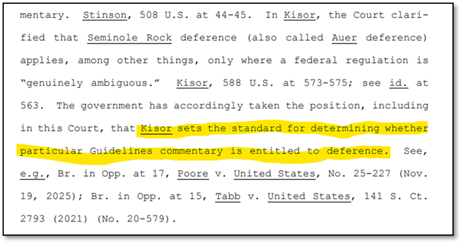
The government went on to argue that whether Kisor is still good law—presumably in light of Loper Bright—is a “question [that] does not warrant this Court’s review,” especially in the “distinct context of the Sentencing Commission’s commentary.” The government is right that there have been repeated denials of petitions seeking review on the applicability of Kisor (as opposed to Stinson) to the Guidelines commentary, notwithstanding a recognized circuit split. One of the more recent cases to receive such a denial, Ratzloff v. United States, raised the distinct issue of how reflexive deference might conflict with “traditional tools of statutory construction,” including the “rule of lenity”—a canon that has special importance vis-à-vis the Sentencing Guidelines. But the Court’s subsequent grant is indicative of a change of heart; it will need to consider what replaces Stinson, and in this sense, it will be hard to dodge re-evaluating Kisor.
It is helpful that the government acknowledges Kisor has displaced Stinson insofar as it believes courts must now exhaust their interpretive tool kit before concluding the Sentencing Guidelines are “genuinely ambiguous.” But as Chief Justice Roberts suggested in Loper Bright, the law rarely runs out; it has a “single, best meaning,” which is discoverable and belongs to the judiciary to exposit. That principle, abstracted from the Section 706 context of Loper Bright, is one of the main reasons why some commentors doubt the long-term viability of Kisor in a post-Chevron environment. It is an issue that will need to be addressed on the merits in Beaird.
Ryan P. Mulvey is Senior Policy Counsel at Americans for Prosperity Foundation. In his role at Cause of Action Institute, Ryan has served as lead counsel on Loper Bright Enterprises v. Raimondo since the initiation of the case.

