
Monsanto, Loper Bright, and Preemption
By
| April 29, 2026
Last week, my colleague, Michael Pepson, noted that Loper Bright might come up during oral argument in Monsanto Company v. Durnell, a case that raises the question of whether the Federal Insecticide, Fungicide, and Rodenticide Act (“FIFRA”) preempts state labeling requirements. Although neither party cited Loper Bright during briefing on the petition for writ of certiorari, the case did come up in the respondent’s answering brief on the merits. Specifically, Mr. Durnell argued that, under Loper Bright, the onus was on Monsanto to “point to text that expressly vests EPA with authority to render conclusive pronouncements on the meaning of FIFRA’s misbranding provisions and their application to particular pesticides.” In other words, unless Congress had expressly given the EPA exclusive jurisdiction to regulate herbicides like Monsanto’s weedkiller, Roundup, there could be no preemption of Mr. Durnell’s failure-to-warn claim under state labeling laws.
The Court heard argument in Monsanto on Monday. As Professor Josh Blackmun has suggested, it seems unlikely Monsanto will be able to find the votes necessary for a ruling in favor of federal preemption. Blackmun’s thoughts on the role of Loper Bright are interesting, too. Again, to understand the relevance of Loper Bright consider the following excerpt from Blackmun’s post:
Everyone agrees the Congress can preempt state law through a statute. But what about when an agency purports to preempt state law through regulations? Under the Chevron regime, the agency would likely get deference when its regulation interprets a complex (ambiguous) statutory regime. But after Loper Bright, does that agency still receive deference? And if the agency does not receive deference, can a state court, in a tort suit, interpret the federal statute to determine if there is federal preemption? In other words, who gets to interpret the statute: the agency or the court. Who decide? Loper Bright would seem to suggest that courts decide legal questions, rather than agencies. Or does Loper Bright note envision a role for state courts to decide the preemptive effect of federal regulations?
As you can read from the argument transcript, Justice Alito was most interested in exploring the Loper Bright connection with counsel for the respondent:
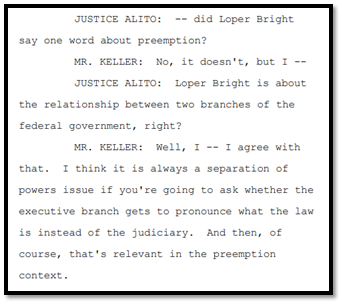
Justice Alito remained skeptical of any direct connection between federal preemption and Loper Bright’s proposition that judges ought to be in the business of interpreting legal question under the APA. Nevertheless, respondent’s counsel continued to push on the principle that “what counts as federal law is relevant to every preemption inquiry.” In this sense, counsel’s argument draws on the constitutional atmospherics of Loper Bright, and the Court’s obvious underlying conceptualization of the Article III role, rather than its strict holding of the impact of Section 706.
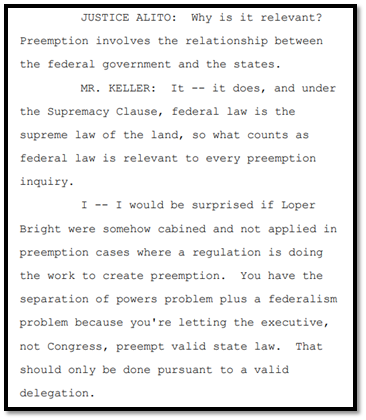
In other words, for the respondent, Loper Bright is not just about the separation of powers and the appropriateness of judicial deference for statutory interpretations adopted by agencies. More broadly (and correctly!), it is about the limits of agency power. Consider, for example, the Loper Bright court’s focus on a judge’s role in policing the boundaries of constitutional delegations—and the implications of that policing for all areas of the law, including preemption. Loper Bright simply cannot be cabined, in this sense, to the administrative-law context.
Notably, Monsanto isn’t the only case where there has been some suggestion that Loper Bright could shift federal preemption law. As I noted the other day, Sixth Circuit Judge Whitney Hermandorfer’s recent concurrence in Rieth-Riley Construction Co., in which she focused on the “shaky footing” of the Garmon doctrine, is worth reading. That doctrine requires state and federal courts to defer to the exclusive competence of the NLRB whenever claims implicate activities arguably covered by National Labor Relations Act. To be sure, Garmon functions more like a jurisdictional bar. But its practical result is to “shunt statutory interpretation questions” away from the courts, which is exactly contrary to the premise of Loper Bright. This seems to coincide with the respondent’s arguments in Monsanto. An agency—or, in this case, its regulated entities—cannot presume the agency enjoys broad authority, or that the scope of its delegation is broad enough to preempt state laws. That is a question of federal law that ought to be determined by courts under the Loper Bright interpretive paradigm.
Ryan P. Mulvey is Senior Policy Counsel at Americans for Prosperity Foundation. In his role at Cause of Action Institute, Ryan has served as lead counsel on Loper Bright Enterprises v. Raimondo since the initiation of the case.

